Showing posts with label Science. Show all posts

Sunday, May 9, 2021

Economics Must Be a Science

 Economics must be a science

--a human science,

 a life science.

 Wealth is basic.

It cannot be the invention of humankind.

It must be traced to the bases of life.

It cannot reside mainly in banks and buildings,

moneys and stock.

Primitive people had wealth

but none of these.


Economics Must Be a Science
Bob Komives


Fort Collins © 2021 :: Economics Must Be a Science  :: 2106


Wednesday, May 27, 2020

Humid Morning on Arid Land


Is this that now hovers
the awaited rain
that will soon descend
to draw our thirst
before refreshment comes to ground?

Or is this no more than past rain that rises
and lingers a while to taunt our thirst
before our fertility departs? 


Humid Morning on Arid Land
Bob Komives


Fort Collins © 2020 :: Humid Morning On Arid Land :: ,8004

Sunday, May 24, 2020

Begat


Energy begat matter.
Matter begat life.
Life begat knowledge.
Knowledge begat culture.
Then culture begat.


Begat
Bob Komives


Fort Collins © 2020 :: Begat :: ,8001

Tuesday, June 25, 2019

Sedimentary Factory


stumbled to note
ancient maketh new


sedimentary factory
makes stackable stone


Sedimentary Factory  
Bob Komives


Fort Collins © 2019  :: Sedimentary Factory  ::  1901

Sunday, November 4, 2018

Sunrise Again in Standard Time


It uplifts the spirit
to walk ourselves back a tiny step toward our planet's nature
to see bright sun 
at what only yesterday
was a dark hour.

Our ancestors
(likely even their ancestors)
knew the meaning of sunrise,
of sunset,
and of the high noon between.

Then,
they begat civilization
which begat commerce and industry
which needed to divide the day and night.
Ancestors gave each a dozen hours.

Sunrise Again in Standard Time
Bob Komives
Then, they begat machines and the skills to make them, which begat a desire to give more precision to the 4 o'clock meet. But, (below and above the equator) the best machinists had trouble making their hours shorter then longer (and then shorter again) as our planet's year progressed. Until, they added the two-dozens into twenty-four equal parts, so the machinists could work their magic, and the voiceless sun would have to rise at a different hour and minute each day. But, it worked-- brilliantly. Then, further offspring, machinists and the mechanics, invented the steam engine and its railroads. They made civilization roll into a leap forward again. Their descendants, (our ancestors and their things) moved so quickly along these roads that it became a problem to know the exact hour here but not there: “When do you depart?” “When might I expect you?” “Can't you just write me down a schedule?” So, their children, our ancestors told us to ignore our personal, local high noon. They settled quite comfortably into time zones. Even breathed sighs of relief. It was good-- for a good time. Until, their children, our mothers and fathers, (at work and at play) found it hard to give up the summer. Crazy as it seemed, little by little, place by place, they pushed summer into winter and called it “savings time.” And most of us say it is good-- for a time. For, our ancestors, our mothers and fathers in adding more “unnatural” to the already “unnatural” gave us a sudden, pleasant, yearly, surprise, and (at dark times) a hope-filled metaphor. For, it uplifts the spirit to walk ourselves back a tiny step toward our planet's nature to see bright sun at what only yesterday was a dark, dark hour.


Bob Komives  ::  Fort Collins © 2018  ::  Sunrise Again in Standard Time  ::  1802
.
.

Friday, October 13, 2017

A More Truthful Confession


Ah, Genius of Science,
I confess I owe you much
for chasing off my curable ignorance
and my primitive superstitions.
Yet, 
here lingers
   an armchair romance,
      a well-couched prejudice,
         a naive daydream,
            a more truthful confession:
A favorite few came back.


A More Truthful Confession
Bob Komives


Bob Komives :: Fort Collins © 2017 ::  1706

Monday, September 15, 2014

Must and Will


       As a planet knows its sun and spin, 
       I must know me.

       As a river lives its bed and flow,                  
       must be myself.

       As each moment fills and embraces its space,                  
       must embrace and love me.

       Now,
       (while I work my way there)

       As a fawn enjoys its wobble,
       I will let me.


 Must and Will
Bob Komives


Bob Komives :: Fort Collins © 1997 :: Must and Will :: ,9701
::::::::::::::::::::::::::::::::::::::::::::::::::::::::::::::::::::::::::::::::::::::::::::::::::::

Friday, May 20, 2011

Quandary, if Obvious and Necessary

..


Quandary, if obvious and necessary,
is not quandary but matter of fact.


Ponder:
how breeze be more vast than its meadow,
   yet meadow be much more than its wind;
how river be greater than valley,
   and valley greater than water within.
how mystery multiplies within and around us
   if in science we explore each nook and space.
And child, neighbor, lover, friend:
how our embrace holds far more than meaning;
   yet meaning holds all we embrace.


Quandary, If Obvious and Necessary
Bob Komives


Fort Collins © 2003 :: Quandary, If Obvious and Necessary :: 0304

Thursday, May 5, 2011

Will Archaeologist Dig Us Up?


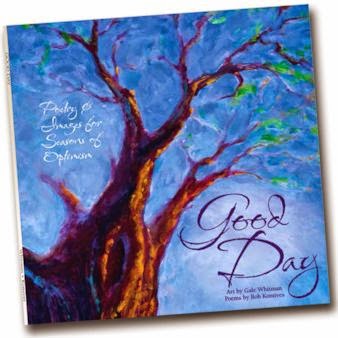
featured in the book Good Day with the art of Gale Whitman


We inter kitchen waste in our garden where it helps us produce
        tomatoes,
        lettuce,
        and beans,
which, in turn, make garden debris and kitchen waste for us to bury where they will help us produce
        tomatoes,
        lettuce,
        and beans.


Will Archeologist Dig Us Up?
Bob Komives


With burning banned and land fill filling, we should match production to our rate of decay. We do not. Our garden rises. Every fifth year we add three and one-half inches of timber around rising vegetables in our risen soil. Elsewhere in our yard the rise is subtle. Our house sinks without moving. Patio and walk descend to become pond and river, while culprit flowers and lawn look innocent.

I never understood why archaeologist must unearth cities, dig down, and further down through past city below, into lost civilization beneath, to disinter them, bring them up and out, from oblivion into history. I did not understand until I noticed my land grow upward at millennial pace toward burial of my home—obscuring:
        noble purpose,
        romance,
        our sense of good citizenship
        in burial of garbage
        where
        and when
        we live.
Our commandments are noble and moral, are they not?
        Live with our garbage!
        Make it useful!

        And, in turn,
        Fight erosion!
Erosion robs soil and nutrient—carries them away as spoil and pollution. I do seek to prevent erosion—have supported its prevention by others. Lately, however, as I inter bucketfuls of kitchen waste I unearth questions:
    Will archaeologist dig us up?
        with purpose?
        by accident?
    How tiny is that likelihood?
        for this era?
        my neighborhood?
    Or, is erosion the only likely future,
        humble accident,
        ignoble story
    that may keep us above oblivion?

Bob Komives :: Fort Collins © 2003 :: Will Archaeologist Dig Us Up? :: 0302

Monday, March 28, 2011

Good Day, Passer-by


featured in the book Good Day with the art of Gale Whitman


Good day, Passer-by,
I watch you pass.
I am pleased when you stop.


Good Day, Passer-by
Bob Komives
 
You see us all around
as you build your city on our ground.
Perhaps because we do not flee
you think us to be thriving.
But we have lost
ninety-nine percent of our land,
ninety-nine percent of our home ground,
the great North American Prairie
where we build and maintain our towns,
where we built cities 

before your species came around.
If we look proud,
we are proud.
Wherever Buffalo roamed we built homes.
We made the great prairie what it was
and can be.
We till the land,
propagate grasses,
release our homes to burrowing owls,
insects,
snakes,
countless species
who do not know how to make a home
unless first we develop the land.
We install utility,
maintain ability
of prairie to be prairie.

Good day, Passer-by.
I am pleased when you stop.
I am Prairie Dog,
a rodent with complex language,
sophisticated society,
commitment to family.
I am your good neighbor.
I know to live with you.
Can you learn and live with me?

I do not care for the eagle,
nor the hawk,
ferret,
coyote,
fox,
nor wolf.
They have taken away family
and want to prey upon me.
Yet I have learned to live with them.
They depend on me.
I am great prairie's great friend.
If you are fond of eagle,
remember me;
I am your great eagle's greater friend.

I am prairie citizen.
On the last one percent of my homeland
I can live with you.
The prairie is passing, Fellow Citizen.
It will slow as you stop,
and it will grow when you show
you can live with me.


Bob Komives :: Fort Collins © 2002 :: Good Day, Passer-by :: 0214

Saturday, March 26, 2011

I am Fibian


I am Fibian

I am Fibian,
northern leopard frog.
This place is one of my spots.
I was once so common
along Cache La Poudre River,
up and down
across North America
you did not count me for much.
But such is history.
Today,
you do not count me for many.
I am Fibian,
cold-blooded amphibian.
Relative to many of my relatives
I am fine
(though in precipitous decline)
because still you can find me.
That is hard to say of my cousin,
Boreal Toad,
supposed to live near the mountain headwater.
He is obviously and officially endangered,
while I am just Fibian,
northern leopard frog,
another amphibian
in the official state of special concern.
I am three and one half inches long.
I take well to cold
but do not freeze.
I eat insects
and other things that would upset your stomach.
Some of you say I am spotted green
to be spotted in the meadow during summer vacation.
Some of you say I am spotted brown
to be spotted in deep water, pond, and wetland.
I crisscross your roads in spring and fall
to prove that none of you is wrong.
But something is wrong
along the river,
around the world.
I am Fibian,
frog, amphibian;
listen up!
When I croak you jump!
In wetland mud I draw a line.
Hop to it and heed my sign:
    Beyond this point
    river stays open
    to song and dance and occasional rhyme,
    but valley is closed
    to amphibian decline.


Bob Komives :: Fort Collins © 2002 :: I am Fibian :: 0213

Monday, March 21, 2011

Partners in Economic Development


Partners in Economic Development

Bob Komives


Where is the evidence
          that scarcity models work?
Where is the evidence     
          that doing the right thing costs too much
          that doing the wrong thing is affordable
          that nations who follow these models become rich?

Wealth is our preoccupation
          --not our invention.
We do not create economic development
          --we are its partner.
Economic development is an organized invasion
          --life invades the universe.
Let us strive to be knowledgeable partner
          --practice stewardship and equity
          --learn
          --share what we learn
          --organize ourselves to foster the biosphere.

Yes,
we must know that wealth can disappear
          --species, ecosystems, languages and cultures become extinct.
We must guard against the disappearance of life itself
          --for only in life does this sphere know to be wealthy.
Prevent the destruction of our species
          --for we can learn as we survive our poor judgment.
Stop exploiting one another
          --together we partake of more wealth more quickly.
Guard against the natural and man-brought disaster
          --that destroys knowledge
          --leaving machines that no one can use
          --books no one can read
          --science no one can remember.

Yes,
we must know that within abundance there is scarcity,
yet within simplistic, dogmatic models of scarcity lie falsehoods.
Within these falsehoods lie too many lessons in fiscal irresponsibility:
          Do not provide for the welfare of the many
          --because resources for the few are scarce.
          Do not clean and protect scarce resources
          --because, well, our resources are scarce.

Yes,
we must know that between the cataclysms
          (brought by meteor, plate, and super volcano)
          life prospers
          abundance patiently overwhelms scarcities
          abundant biosphere enables civilization.
Within biosphere and civilization lie truths.
Within these truths lie our lessons in fiscal responsibility:
          Well-being requires investment.
          Good investment nourishes and improves life.
          Poor investment risks disaster.

There is no evidence
          that doing the right thing costs too much,
          that doing the wrong thing is affordable?

Evident, indeed, is knowledge of abundance
embedded by life into biosphere and civilization.

As better we know this
as better we become
          partners in economic development.


Bob Komives :: Fort Collins © 2011 :: Partners In Economic Development :: 1102

Friday, February 25, 2011

Capture Broadly


Capture broadly--
   as leaf captures sun,
      mill captures wind,
         and harvester gathers grain.

Capture Broadly
Bob Komives
Distribute deeply--
   as leaf sends oxygen,
      mill delivers flour,
         and parent feeds child
            that teacher educates.


Recirculate densely--
   as we bake for our miller,
      who rewards our harvester,
         who buries our excess
               to reward the roots
                  who will feed new leaves.
                     to nourish grains of life.


Bob Komives :: Fort Collins © 2007 :: Capture Broadly ::0713
-------------------------------------------

Monday, October 18, 2010

Second-Grade Truth


.
.
Lake shore is curvaceous
through microscope and telescope.
Sword has two edges,
as does blade of grass,
as do rainy season and lover's shoulder.
Second-Grade Truth
Bob Komives
My years resemble my months
during this moment
when I puzzle
over excitement
and disappointment
in this group
in this place,
and I see a truth
that I often discover
because I often forget.
I see in a crosscut of my memory
a slice through an old group
of long-ago children,
second-grade schoolmates,
who are the like
of this group today
and countless groups,
elite and humble,
big and small,
entered and fallen away
each fresh,
each unique
until the moment of disillusion
when I see forgotten truth
in slices taken
(statistician slices)
(intuition slices)
for intelligence and sadness,
for humor and athleticism,
for effort,
loyalty,
homeliness and beauty.
I wonder if I often forget my schoolmates
because I fear life will be dull if I remember.
Am I addicted to rediscovery
of myriad truths joining present to past?
I wonder if we train our scientists
more to not forget
than to discover--
leaving the fun of rediscovery to the rest of us.

This moment
I see selfishness and charity.
I notice they look the same
sliced across farmers, villagers, poor people,
across city folk, suburban folk, rich people,
across second-grade schoolmates
and graduate school colleagues.
I see lake shore is curvaceous
through microscope and telescope.
Sword has two edges,
as does blade of grass,
as do rainy season and lover's shoulder.
My years resemble my months.
A profile of my distant day on a train in Italy
mimics ten minutes in this morning's garden.
Despite these symmetries,
because of these symmetries, 
beauty hides in place and moment
to find and forget,
to lose and remember
with rainy season
and lover's shoulder.


Bob Komives :: Fort Collins © 2001 :: Second-Grade Truth :: 0108


Tuesday, July 20, 2010

Leaf On My Floor


featured in the book Good Day with the art of Gale Whitman


You, leaf on my floor,
inside my house,
in through my door,
you, done with your work,
unwanted leaf,
get out!
out to my fire to burn!

Leaf On My Floor
Bob Komives
 
I, boot on your stem,
bend,
blood to my head,
stop,
kink to my back,
feel,
guilt to my heart,
smile,
time to rethink.

          
You, leaf on my floor,
found under foot,
blown through the door:
I know
generations of your ancestors
helped my tree
make energy from sun,
grow,
give out seeds
and give me beauty;
I know
this year's beauty included you.

     
I, months ago,
        said to a friend,
       look at the beauty in that tree leafing out.
Weeks ago,
       I said, look!
       look at the beauty in that tree turning red.
Hours ago,
       I said, look outside!
       as leaves fell beautifully in autumn wind.
Now,
       some class of hypocrite am I
       to treat a leaf on my floor
       as clod of waste to put out the door.
 

If this were a just world
I would be found guilty of leaf slaughter
or reckless abandonment,
imprisoned in a cell
where I could see no leaf,
no tree,
no change of season;
in a cell so clean
it could never know you
nor twig,
nor seed,
nor speck of fertile mud.

           
I, blood into my heart,
guilt out through my head,
pride straight up my back,
say, come now,
dear Leaf,
dear Retired Leaf.
I take you up from my floor,
back through my door,
to beneath our tree
and set you gently to rest.


Bob Komives :: Fort Collins © 2001 :: Leaf On My Floor :: 0107